Optimizing Your 48-Hour Route — How to Plan Time, Transport Options, and Map a Seamless Museum-to-Café-to-Rooftop Day
- Optimizing Your 48-Hour Route — How to Plan Time, Transport Options, and Map a Seamless Museum-to-Café-to-Rooftop Day
For travelers exploring Indonesia, especially those navigating the vibrant chaos of cities like Jakarta or the cultural density of areas in Bali, maximizing a short stay is crucial. A 48-hour window demands precision, flexibility, and a deep understanding of local logistics. This guide focuses on **Optimizing Your 48-Hour Route** by strategically planning time, mastering transport options, and mapping a dynamic itinerary that smoothly transitions from cultural immersion (museums) to leisure (cafés) and culminates in breathtaking views (rooftops).
The Indonesian Traveler’s Advantage: Why 48 Hours Is Enough
Indonesia offers concentrated experiences. In a major hub, historical sites, modern art spaces, and world-class dining often cluster together. The challenge isn’t finding things to do, but efficiently connecting the dots. By viewing your 48 hours as four distinct 12-hour blocks, you can structure two perfect days that capture the essence of the destination without feeling rushed.
Defining Your Priorities (Museum, Cafe, Rooftop)
Before booking anything, define the specific type of experience you seek. Are you interested in the history housed within Jakarta’s National Museum, or the contemporary art scene in Bandung? Does your ideal café offer traditional Indonesian coffee or a sleek, digital nomad workspace? Prioritization dictates the geographical area you choose to focus on, immediately limiting unnecessary transit time.
Phase 1: Strategic Time Allocation and Mapping
The biggest enemy of the 48-hour traveler in Indonesia is traffic, especially in dense urban centers. Successful planning relies on ‘Geo-Grouping’—clustering all target destinations within a small, navigable radius. Use a mapping application (like Google Maps) to visually plot your museum, café, and rooftop choices for Day 1 and Day 2. If the points are too scattered, choose replacements that are geographically closer.
Pro Tip: Geo-Grouping Example (Jakarta)
If you visit the National Museum (Museum Nasional) in Central Jakarta, your café stop should be in the nearby Menteng area, and your rooftop bar should be one of the tall buildings in Thamrin or Sudirman, minimizing travel time to under 30 minutes between points.
Time Blocking: The 4/4/4 Rule
To ensure a seamless flow, allocate time strictly. The 4/4/4 rule provides a robust framework for a single day:
- **Morning (Culture/Learning): 4 Hours.** Dedicate the freshest part of the day (9:00 AM – 1:00 PM) to museums or historical sites. This is when crowds are lighter and your energy is highest.
- **Afternoon (Leisure/Refuel): 4 Hours.** Use this time (1:00 PM – 5:00 PM) for your café visit, lunch, shopping, and essential rest. This buffer prevents burnout.
- **Evening (Transit/View/Dinner): 4 Hours.** The final block (5:00 PM – 9:00 PM+) is reserved for the sunset view, travel to the rooftop, dinner, and relaxation.
Phase 2: Mastering Indonesian Transport Options
In Indonesia, especially in major islands, transportation is dominated by digital platforms and highly personalized options. Relying solely on taxis or unfamiliar public transit can eat into your precious 48 hours. The key is knowing when to use speed, and when to use comfort.
Gojek and Grab: The Digital Backbone of Urban Travel
Gojek and Grab are indispensable. They offer transparent pricing and reliable service. For short distances or when traveling with luggage, the car option (GoCar/GrabCar) is comfortable. However, when traffic is gridlocked (mid-day or evening rush hour), the motorcycle taxi service (GoRide/GrabBike) is often the only way to maintain your schedule. Always download both apps and ensure you have a local SIM card for easy communication with drivers.
Utilizing Mass Transit (MRT/TransJakarta)
In cities like Jakarta, the newly developed MRT and the extensive TransJakarta bus rapid transit system offer predictable, low-cost travel, especially for longer, straight-line routes. Use these systems to cover large distances quickly outside of your Geo-Group cluster, then switch to Gojek/Grab for the ‘last mile’ travel. Ensure you purchase an electronic fare card (e.g., e-money card) upon arrival.
Phase 3: Crafting the Seamless Route (The Day Itself)
The success of **optimizing your 48-hour route** hinges on the transition points. Don’t book tickets or reservations that require you to be at a specific place at a specific time unless absolutely necessary. Maintain flexibility, but follow the morning-to-evening flow diligently.
| Time Block | Activity Focus | Goal |
|---|---|---|
| 9:00 AM – 1:00 PM | Museum/Culture | Intellectual stimulation, cooler temperatures. |
| 1:00 PM – 5:00 PM | Café/Leisure | Rest, hydration, light work, avoiding peak traffic. |
| 5:00 PM – 9:00 PM+ | Rooftop/Views | Sunset viewing, dinner, and relaxation. |
Morning Culture Fix (Museums/Historical Sites)
Start early. Indonesia’s heat and humidity peak mid-day, making indoor, air-conditioned museums ideal morning destinations. Check opening hours beforehand; many smaller museums open later than 9 AM. If you are in Bali, dedicate the morning to temple visits (like Tanah Lot or Uluwatu) before the major tour buses arrive.
Midday Recharge (Café Culture)
Indonesian café culture is world-class. Use this time to recharge your devices, enjoy local specialties like Kopi Luwak (ethically sourced, if possible) or cold brews, and write postcards. Crucially, this period acts as a downtime buffer. If your museum visit ran long, you can cut the café time short without impacting the evening plan. If you are on schedule, use this time to finalize your evening transport booking.
Watch this video for general travel planning tips to enhance your efficiency:
Evening Zenith (Rooftop Views)
The rooftop view is the perfect reward for a well-planned day. Aim to arrive at your chosen rooftop bar or vantage point (like a hill in Yogyakarta or a high-rise in Surabaya) approximately 30 minutes before sunset. This ensures you secure a good spot and witness the transition of the Indonesian sky. Since you are likely tired, choose a rooftop close to your accommodation for an easy final ride home.
Essential Tech Tools for Route Optimization
Effective 48-hour planning requires digital assistance. Beyond Gojek and Grab, utilize offline maps. Download the map of your target city (e.g., Semarang, Medan) using Google Maps or a dedicated app like Maps.me. This allows you to check distances and alternative routes even if mobile data is temporarily unavailable.
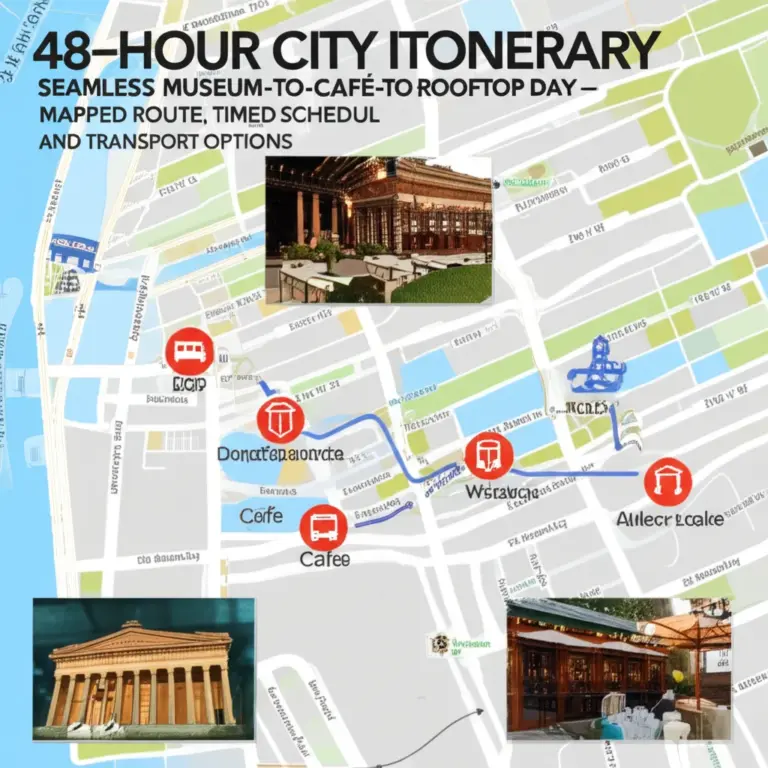
Plotting your route visually is key to understanding the geographical demands of your itinerary. Use the map below to visualize how Geo-Grouping can cluster your destinations effectively:
คำถามที่พบบ่อย (FAQ)
References
- Jakarta City Break 48-Hour Plan for Museums, Coffee and Rooftop Views: The Ultimate Weekend Itinerary
- Best Museums to Visit in Jakarta in 48 Hours — What to See, Opening Hours and Ticket Tips for History and Art Lovers
- Cafés and Coffee Culture Near Jakarta’s Museums — Where to Grab Specialty Coffee, Local Snacks and Work-Friendly Spots