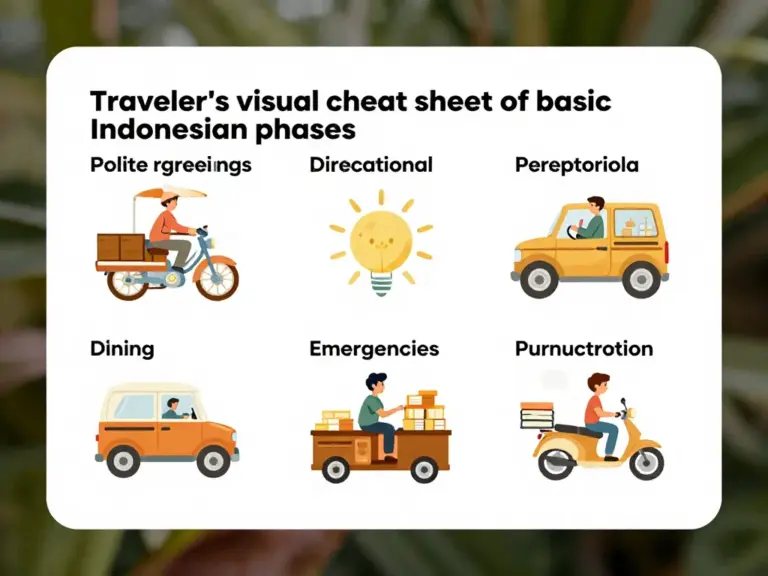
Learning Basic Indonesian Phrases: A Traveler’s Cheat Sheet — Quick Guide for Polite Greetings, Directions, Dining, Emergencies, and Pronunciation Tips
- Learning Basic Indonesian Phrases: A Traveler’s Cheat Sheet — Quick Guide for Polite Greetings, Directions, Dining, Emergencies, and Pronunciation Tips
Embarking on a journey to the stunning archipelago of Indonesia is an adventure of a lifetime. While many Indonesians in tourist hubs like Bali or Jakarta speak English, Learning Basic Indonesian Phrases can transform your travel experience. It opens doors to authentic interactions, shows respect for the local culture, and helps you navigate the islands with confidence. Bahasa Indonesia is surprisingly accessible for English speakers as it uses the Latin alphabet and has no complex grammatical conjugations.
Understanding the Basics: Pronunciation Tips
Before diving into the phrases, let’s look at how to say them. Indonesian is a phonetic language, meaning it is generally pronounced exactly as it is written. Here are a few key rules:
- C is always pronounced like ‘ch’ in ‘check’ (e.g., Candi is ‘Chan-dee’).
- G is always hard, like ‘goat’, never soft like ‘giraffe’.
- R is usually trilled or rolled.
- Vowels: ‘A’ is like ‘father’, ‘E’ is like ‘bet’ or ‘ago’, ‘I’ is like ‘see’, ‘O’ is like ‘hot’, and ‘U’ is like ‘moon’.
Essential Polite Greetings and Etiquette
Indonesians are known for their warmth and hospitality. Starting a conversation with a polite greeting is the best way to build rapport. In Indonesia, greetings are often based on the time of day.
| English | Indonesian | Context |
|---|---|---|
| Good Morning | Selamat Pagi | Until 11 AM |
| Good Day | Selamat Siang | 11 AM – 3 PM |
| Good Afternoon | Selamat Sore | 3 PM – 6 PM |
| Good Evening | Selamat Malam | After 6 PM |
| Thank You | Terima Kasih | Very Important! |
| You’re Welcome | Sama-sama | Response to thanks |
| Excuse Me / Sorry | Permisi / Maaf | Polite navigation |
Whether you are catching a ‘Blue Bird’ taxi, a ‘Gojek’ bike, or wandering through a local ‘Pasar’ (market), these directional phrases are vital.
- Where is…? – Dimana…?
- Turn Left – Belok Kiri
- Turn Right – Belok Kanan
- Straight ahead – Lurus saja
- Stop here – Berhenti di sini
- How much (price)? – Berapa harganya?
- Too expensive! – Terlalu mahal! (Use this playfully when bargaining).
Dining Out: Ordering Food and Drinks
Indonesian cuisine is a highlight for any traveler. From Nasi Goreng to Satay, your taste buds are in for a treat. Use these phrases at a ‘Warung’ (local eatery) to order like a pro.
- I want to order… – Saya mau pesan…
- Not Spicy – Tidak pedas (Crucial if you can’t handle chili!)
- Vegetarian – Vegetarian / Tanpa daging
- Delicious! – Enak!
- The bill, please – Minta bon / Minta tagihan
- Drinking water – Air putih
Emergency Phrases: Staying Safe
While we hope your trip is smooth, it is always wise to be prepared for the unexpected.
- Help! – Tolong!
- I am sick – Saya sakit
- Hospital – Rumah Sakit
- Police – Polisi
- I lost my… – Saya kehilangan…
Conclusion
Learning Basic Indonesian Phrases is more than just a linguistic exercise; it is a bridge to the heart of Indonesia. By making the effort to speak even a few words, you show that you value the local culture and people. Keep this cheat sheet handy, practice your pronunciation, and get ready for a more immersive and rewarding travel experience in Wonderful Indonesia!
คำถามที่พบบ่อย (FAQ)
Is Indonesian hard to learn for English speakers?
No, it is considered one of the easiest Asian languages for English speakers because it uses the Latin alphabet, has no tones, and features relatively simple grammar.
Do I need to be fluent to travel in Indonesia?
Not at all. While fluency is great, knowing basic greetings, numbers, and directional phrases is usually enough for most travelers in tourist areas.
How do I say ‘No’ politely?
You can say ‘Tidak’ for ‘No’, but ‘Belum’ (Not yet) or ‘Tidak, terima kasih’ (No, thank you) is often considered more polite in social contexts.
What is the most important phrase to know?
‘Terima kasih’ (Thank you) is the most important phrase, as expressing gratitude is a cornerstone of Indonesian social interaction.
References
- Why Learn Indonesian for Travel? Understanding Search Intent, Common Situations, and What Travelers Actually Need
- Essential Indonesian Phrases for Travelers: Greetings, Asking Directions, Transport, Ordering Food, and Polite Expressions (with Long-tail Examples)
- Handling Emergencies and Health Situations in Indonesian: Key Phrases, Phone Calls, and How to Ask for Help Locally