Sasak Villages of Lombok Handweaving Architecture and Etiquette: A Complete Guide for Visitors and Cultural Enthusiasts
- Sasak Villages of Lombok Handweaving Architecture and Etiquette: A Complete Guide for Visitors and Cultural Enthusiasts
- The Architectural Marvels of Sasak Villages
- The Soul of the Village: Handweaving (Songket)
- Visitor Etiquette: Respecting Sasak Traditions
- Why Visit Sade and Ende Villages?
- คำถามที่พบบ่อย (FAQ)
- What is the best time to visit Sasak villages?
- Is there an entrance fee for Sade Village?
- Can I learn how to weave in the village?
Lombok, an island in Indonesia’s West Nusa Tenggara province, is renowned not just for its pristine beaches and the majestic Mount Rinjani, but also for its rich indigenous culture. Central to this identity are the Sasak people, the island’s original inhabitants. For those seeking an authentic cultural immersion, exploring the Sasak Villages of Lombok Handweaving Architecture and Etiquette offers a profound journey into a way of life that has remained remarkably preserved despite the pressures of modern tourism. This guide delves into the structural marvels of their homes, the intricate art of their textiles, and the essential social norms every visitor should respect.
The Architectural Marvels of Sasak Villages
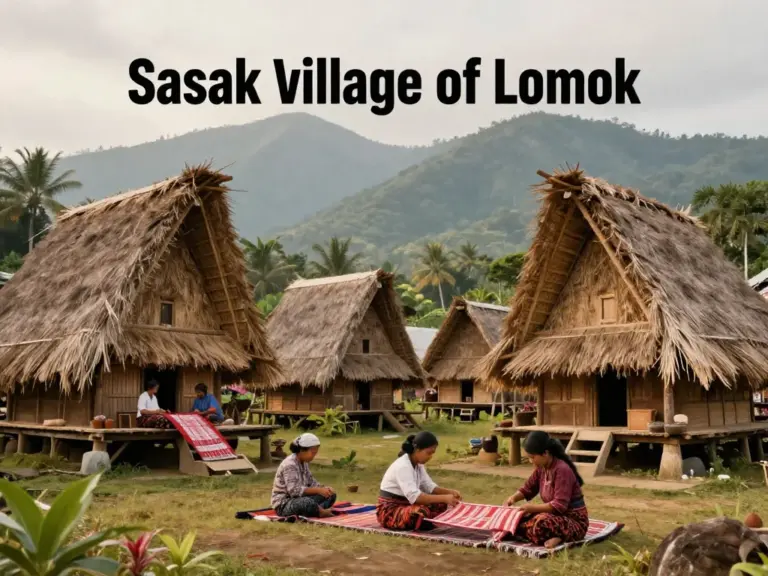
When you step into a traditional Sasak village like Sade or Ende, the first thing that captures your attention is the unique architecture. The Sasak Villages of Lombok Handweaving Architecture and Etiquette are defined by structures built entirely from natural materials sourced from the surrounding landscape. These homes, known as Bale, are designed with both functionality and spiritual symbolism in mind.
The Bale Tani (farmers’ house) is the most common dwelling. Its walls are made of woven bamboo (anyaman), and the high-pitched, thatched roofs are crafted from alang-alang grass. Perhaps the most surprising feature is the floor, which is traditionally made from a mixture of clay and cow dung. While this may sound unusual to Western visitors, the dung creates a hard, dust-free surface that is remarkably clean and acts as a natural insect repellent when dried and polished.
Iconic Structures: The Rice Barns
No Sasak village is complete without the Lumbung. These are distinctive rice barns with a bonnet-shaped roof that has become a symbol of Lombok tourism. Elevated on stilts to protect the harvest from rodents and moisture, the Lumbung represents the community’s prosperity and their deep connection to the land and agriculture.
The Soul of the Village: Handweaving (Songket)
A vital component of the Sasak Villages of Lombok Handweaving Architecture and Etiquette is the art of Songket. For Sasak women, weaving is more than just a craft; it is a rite of passage. Traditionally, a Sasak woman cannot marry until she has mastered the art of weaving. Walking through the village, you will see women of all ages sitting at backstrap looms, meticulously creating vibrant textiles with intricate geometric patterns.
| Pattern Name | Symbolism |
|---|---|
| Subahnale | Gratitude to God (Complexity of design) |
| Keker | Peace and Love (Peacock motif) |
| Tokek | Good Luck and Protection (Gecko motif) |
The process is incredibly labor-intensive, sometimes taking weeks or months to complete a single piece. The threads are often dyed using natural pigments from plants and minerals, ensuring that each sarong or wall hanging is a unique piece of cultural heritage.
Visitor Etiquette: Respecting Sasak Traditions
To truly appreciate the Sasak Villages of Lombok Handweaving Architecture and Etiquette, one must behave as a respectful guest. The Sasak people are incredibly hospitable, but they hold their traditions (Adat) in high regard. Following these simple rules ensures a positive experience for both you and the local community:
- Dress Modestly: Wear clothing that covers your shoulders and knees. This is a sign of respect for the local Islamic values.
- Ask Before Filming: While photography is generally welcomed, always ask for permission before taking close-up portraits of villagers.
- Remove Shoes: If you are invited inside a Bale (home), always remove your shoes at the entrance.
- Support Locally: Purchasing a handwoven textile directly from the weaver is the best way to support the village economy.
Why Visit Sade and Ende Villages?
While there are many Sasak settlements, Sade and Ende are the most accessible for visitors. These villages function as living museums. Unlike modern towns, they have consciously chosen to maintain their traditional lifestyle. Here, you can witness the Presean (stick fighting) dance, observe the daily communal life, and understand the deep-rooted values of the Sasak Villages of Lombok Handweaving Architecture and Etiquette.