Which symbols, offerings, music, and attire are used in Balinese rituals and what do they represent?
- Which symbols, offerings, music, and attire are used in Balinese rituals and what do they represent?
Balinese Hinduism, or Agama Tirta (Religion of Holy Water), is a vibrant tapestry woven from deep spiritual beliefs, intricate ceremonies, and stunning aesthetic expressions. For visitors to Indonesia, understanding which symbols, offerings, music, and attire are used in Balinese rituals and what do they represent? is key to appreciating the island’s profound cultural rhythm. Every element, from the smallest flower arrangement to the grandest Gamelan performance, carries layers of meaning, connecting the human world (Bhuwana Alit) with the cosmic realm (Bhuwana Agung). This guide delves into the essential components of Balinese ritual life, offering an expert perspective on their significance.
The Central Role of Offerings (Banten)
Offerings, known collectively as Banten, are arguably the most visible and constant aspect of Balinese daily life. They are not mere gifts; they are acts of purification and gratitude, essential transactions between humanity and the divine spirits and demons. The complexity of a Banten often reflects the importance of the ceremony.
Types and Meanings of Key Offerings
Offerings are typically categorized based on their recipient, following the concept of Tri Bhuana (Three Worlds):
- Banten Yadnya (For Deities): Placed in high temples or shrines. These are generally the most elaborate, often featuring fresh fruits, flowers, incense, and symbolic cakes.
- Banten Bhuta Yadnya (For Lower Spirits/Demons): Placed on the ground or crossroads (like the Cawan or Sajen). These appease negative forces, preventing them from disturbing the balance.
- Banten Manusa Yadnya (For Human Life Cycles): Used in rites of passage ceremonies like birth, tooth filing, and cremation.
The Symbolism of Flowers and Food
Flowers are crucial. The color often dictates meaning:
- White (Pucuk): Purity, often dedicated to Shiva.
- Red (Rempug): Courage or the domain of Brahma.
- Yellow (Kuning): Prosperity, often associated with Vishnu.
- Black/Dark Colors: Representing the realm of the lower spirits or Durga.
Rice (Nasi) is fundamental, symbolizing sustenance and life itself, often shaped into small, symbolic mounds.
Sacred Symbols and Iconography
Balinese ritual spaces are rich with visual cues, deeply rooted in Hindu cosmology. These symbols act as shorthand for complex theological concepts.
The Significance of the Tri Murti
The three primary Hindu deities are omnipresent:
- Brahma (The Creator): Often symbolized by the color red and the East.
- Vishnu (The Preserver): Symbolized by the color yellow and the South.
- Shiva (The Destroyer/Transformer): Symbolized by the color white and the West.
Temple Architecture and Orientation
The structure of a temple itself is a symbol. The central courtyard, the Jeroan, houses the highest shrines, oriented toward the sacred mountain, Mount Agung (considered the abode of the gods). The split gate, Candi Bentar, symbolizes the division between the outer world and the sacred inner sanctuary.
Ritual Attire: Dressing for the Sacred Space
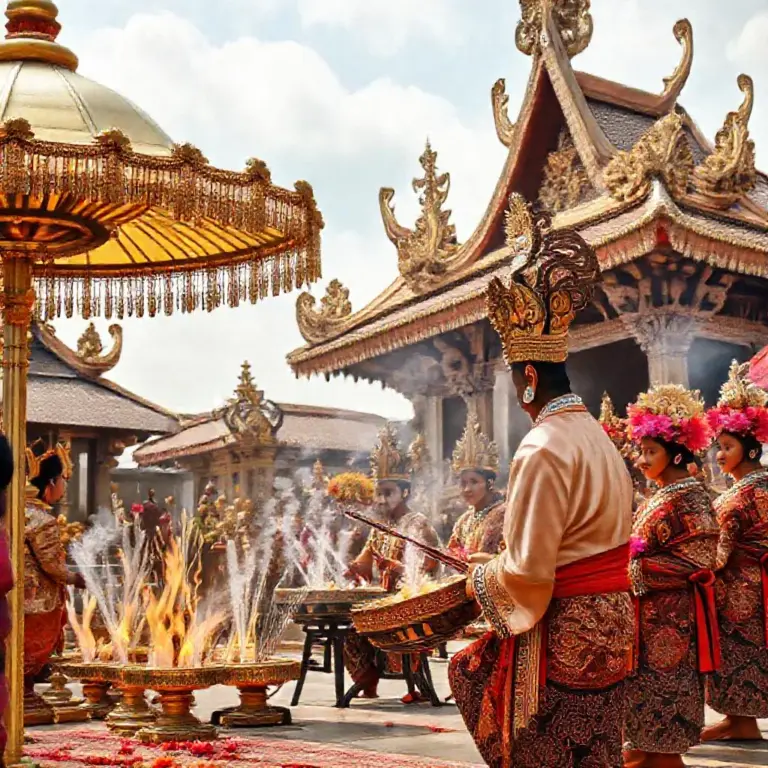
When attending a Balinese temple ceremony, appropriate attire is mandatory, signifying respect and spiritual readiness. The required clothing reflects the concept of covering the body appropriately before approaching the divine presence.
The Essential Components of Balinese Dress
For both men and women, the dress code involves three main elements:
Furthermore, men typically wear a head covering called an Udeng, which is intricately folded to symbolize the alignment of the body with the cosmos.
The Soul of Ceremony: Balinese Music (Gamelan)
No Balinese ritual is complete without the hypnotic, complex soundscape of the Gamelan orchestra. This music is not entertainment; it is a spiritual necessity, creating the vibrational environment required for the gods to descend and the spirits to be appeased.
Gamelan and Its Purpose
The Gamelan ensemble consists primarily of bronze percussion instruments—gongs, metallophones, and cymbals. Unlike Western music, which often follows a linear melody, Gamelan music is cyclical and layered, representing the continuous cycle of life, death, and rebirth.
The specific type of Gamelan used depends on the ritual. For instance, Gamelan Gong Kebyar, known for its sharp, dynamic contrasts, is often used in large temple festivals, while quieter ensembles may accompany more intimate spiritual meditations. The music acts as the ‘voice’ of the ceremony, facilitating communication across realms.
Witnessing the Ritual Sound
To truly grasp the auditory experience, it is essential to see the musicians in action. Here is a short video illustrating the energy of a traditional Balinese Gamelan performance.
Connecting the Elements: Ritual Flow
The culmination of these elements—symbols, offerings, sound, and dress—occurs during the core ritual acts. For example, during a temple anniversary (Odalan), the attire shows respect, the Gamelan sets the sacred tone, and the offerings are presented at specific altars dedicated to different deities and ancestral spirits. The purification ritual involving holy water (Tirta Yatra) is central, representing the washing away of impurities.
For tourists planning to visit Bali, respecting these deeply ingrained traditions is paramount. Always dress modestly, follow temple guidelines regarding head coverings and sashes, and observe ceremonies with reverence. By understanding the meaning behind the symbols, offerings, music, and attire used in Balinese rituals, you move beyond mere sightseeing to genuine cultural immersion.
คำถามที่พบบ่อย (FAQ)
References
Official Bali Tourism Resources
UNESCO Intangible Cultural Heritage Listings