Planning your route and logistics: recommended itinerary, must‑see volcanoes (Tangkuban Perahu, Ijen, Bromo), road conditions, vehicle options, permits, and safety tips
- Planning your route and logistics: recommended itinerary, must‑see volcanoes (Tangkuban Perahu, Ijen, Bromo), road conditions, vehicle options, permits, and safety tips
- Recommended Itinerary: The Trans-Java Volcanic Trail
- Must-See Volcanoes: Tangkuban Perahu, Bromo, and Ijen
- Road Conditions and Vehicle Options
- Permits and Entrance Requirements
- Safety Tips for Volcanic Exploration
- คำถามที่พบบ่อย (FAQ)
- What is the best time of year to visit Java’s volcanoes?
- Do I need to be physically fit to hike Bromo and Ijen?
- Is it safe to visit an active volcano?
Indonesia is a land defined by fire and emerald landscapes. For travelers seeking the ultimate adventure, planning your route and logistics for a volcanic expedition across Java is essential. From the steaming craters of Tangkuban Perahu in the west to the ethereal blue flames of Ijen in the east, this guide provides a comprehensive roadmap for navigating the Ring of Fire safely and efficiently.
Recommended Itinerary: The Trans-Java Volcanic Trail
A complete volcanic circuit of Java typically requires 10 to 14 days. This allows for travel time between provinces and recovery after midnight hikes. A popular route starts in Jakarta, moves through Bandung, heads east to Yogyakarta, and concludes at the majestic peaks of East Java.
- Days 1-3: West Java (Bandung) – Visit Tangkuban Perahu and Kawah Putih.
- Days 4-6: Central Java (Yogyakarta) – Explore Mount Merapi (via Jeep tour) and cultural landmarks.
- Days 7-9: East Java (Probolinggo) – The iconic Mount Bromo sunrise trek.
- Days 10-12: East Java (Banyuwangi) – The midnight climb to Ijen Crater for the blue fire.
Must-See Volcanoes: Tangkuban Perahu, Bromo, and Ijen
Each volcano offers a distinct geological personality. Tangkuban Perahu is unique because you can drive right up to the rim of the Queen’s Crater (Ratu Crater). It is famous for its ‘upturned boat’ shape and the pungent smell of sulfur rising from the depths.
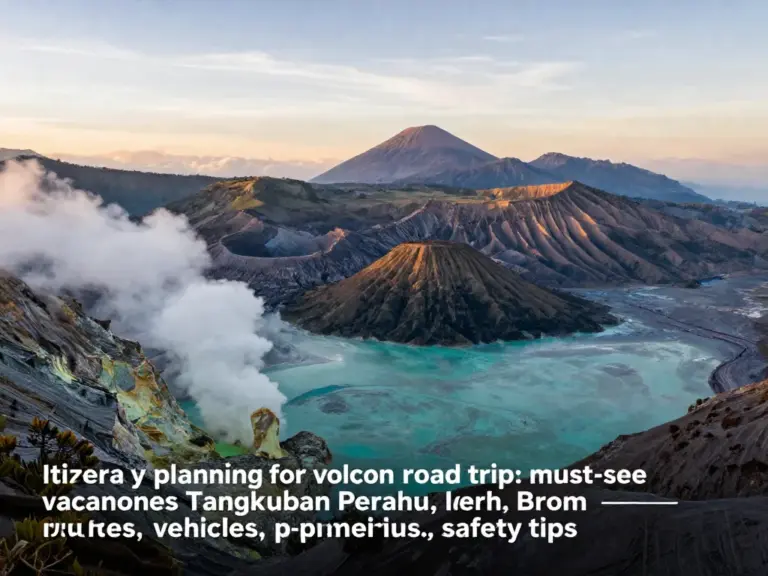
Mount Bromo, situated in the Bromo Tengger Semeru National Park, is perhaps Indonesia’s most photographed landmark. The vast ‘Sea of Sand’ surrounding the active vent creates a lunar landscape that is best viewed from the Penanjakan viewpoint at dawn. Finally, Ijen Crater is world-renowned for its turquoise acid lake and the rare ‘Blue Fire’ phenomenon, caused by ignited sulfuric gases.
Road Conditions and Vehicle Options
Road conditions in Java vary significantly. While the Trans-Java Toll Road connects major cities efficiently, the roads leading to volcano base camps are often narrow, steep, and winding. Vehicle options are a critical part of planning your route and logistics. For city-to-city transfers, a standard MPV (like a Toyota Avanza) is sufficient. However, for Bromo and Ijen, a 4WD Jeep is mandatory to navigate the rugged terrain and steep inclines.
| Region | Terrain Type | Recommended Vehicle |
|---|---|---|
| West Java (Tangkuban Perahu) | Paved, Winding | Standard Car / Bus |
| East Java (Mount Bromo) | Sandy, Extremely Steep | 4WD Jeep (Mandatory) |
| East Java (Ijen) | Paved but Steep | Private Car / SUV |
Permits and Entrance Requirements
Most national parks in Indonesia now require online booking. For Mount Bromo, visitors must book via the official website of the Bromo Tengger Semeru National Park. For Ijen, tickets can often be purchased at the Paltuding base camp, but a medical certificate of health is sometimes required due to the strenuous nature of the climb and the presence of toxic gases. Always carry a digital and physical copy of your ID or passport.
Safety Tips for Volcanic Exploration
Safety is paramount when planning your route and logistics in volcanic zones. The environment can be unpredictable. Here are essential safety measures:
- Gas Masks: Essential for Ijen Crater to protect against high concentrations of sulfur dioxide.
- Warm Clothing: Temperatures at Bromo and Ijen can drop to 0-5°C before sunrise.
- Footwear: Wear high-traction hiking boots; volcanic ash and gravel are slippery.
- Local Guides: While not always mandatory, hiring a local guide supports the local economy and ensures you stay on safe paths.
คำถามที่พบบ่อย (FAQ)
References
For more information on planning your trip, visit the Official Indonesia Tourism Website or check the MAGMA Indonesia Volcanic Activity Portal.
- Java Overland Road Trip Bandung to Surabaya with Volcanoes and Coffee Stops
- Why travelers choose the Bandung–Surabaya overland route: trip overview, ideal duration, best seasons, and what to expect on a volcanic and coffee‑themed journey
- Coffee culture en route: top coffee plantations and cafes to visit, tasting notes, farm tours, and how to arrange ethical coffee experiences