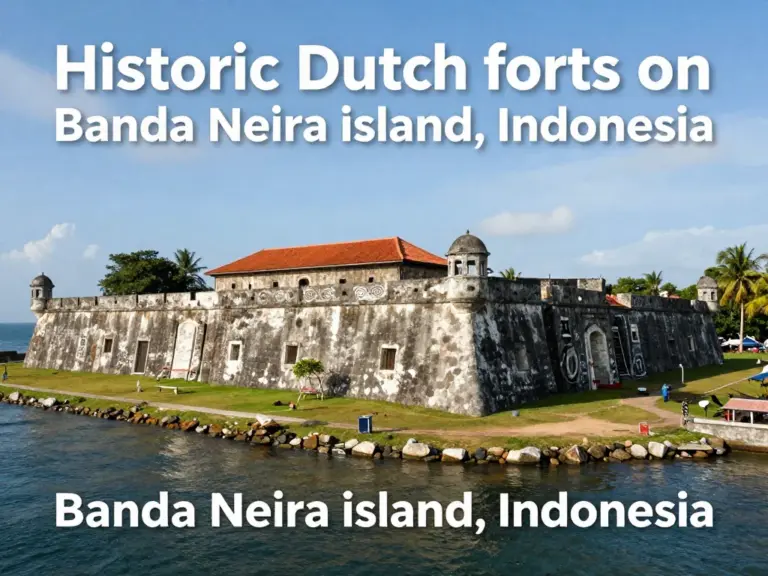
The Historic Heart of Banda Neira: Why the Dutch Forts Matter
Stepping onto the shores of Banda Neira feels less like a vacation and more like walking through a preserved page of history. As the epicenter of the global spice trade during the 17th century, this tiny archipelago in the Maluku Islands was once the most coveted piece of real estate on Earth. At the center of this narrative lies The Historic Heart of Banda Neira, anchored by a series of formidable Dutch forts that have stood as silent sentinels for centuries.
Understanding these structures is essential for any traveler seeking to grasp the complex colonial legacy of Indonesia. These fortifications are not merely crumbling stone walls; they are the physical remnants of a struggle for control over nutmeg—a spice once worth its weight in gold.
The Significance of Fort Belgica
Dominating the skyline of the main island, Fort Belgica is the undisputed jewel of the Dutch colonial architecture in the region. Built in 1611, this pentagonal fortress was designed to protect the Dutch East India Company’s (VOC) monopoly on the nutmeg trade from both local resistance and competing European powers. Its strategic placement on a hill provides a panoramic view of the Banda Sea and the towering peak of Mount Api, a sight that has captivated visitors for generations.
Walking through the heavy iron gates of Fort Belgica, one can almost hear the echoes of the past. The architecture, with its bastions and central courtyard, is a prime example of 17th-century European military engineering adapted to the tropical landscape of the East Indies. It serves as a stark reminder of the immense wealth that flowed through these waters and the heavy cost paid by the indigenous Bandanese people.
Other Forts and the Colonial Landscape
While Fort Belgica is the most famous, it is not the only historic site that makes up The Historic Heart of Banda Neira. Fort Nassau, the oldest Dutch fort on the island, offers a more intimate look at the early days of colonial occupation. Situated near the waterfront, it provides a different perspective on how the Dutch established their initial foothold in the region.
| Fort Name | Historical Context |
|---|---|
| Fort Belgica | The primary military stronghold, built to overlook the entire harbor. |
| Fort Nassau | The earliest Dutch construction, serving as the first administrative center. |
| Fort Hollandia | Located on Lonthoir, essential for controlling the nutmeg groves. |
Why These Forts Matter Today
Beyond their historical value, these forts are vital for modern tourism and cultural preservation. They help define the identity of Banda Neira, transforming it into an open-air museum. For the local community, these sites are a source of pride and a tangible connection to their ancestors’ history. For tourists, they provide a necessary context to understand Indonesia’s journey from a collection of spice-producing kingdoms to a unified nation.
Visiting these sites encourages a deeper engagement with the history of globalization. The spice trade centered here changed the course of world history, and these walls witnessed the beginning of that transformation.
คำถามที่พบบ่อย (FAQ)
1. Is Fort Belgica open to the public?
Yes, Fort Belgica is open to the public and is one of the most well-maintained historic sites in the Banda Islands. You can explore the ramparts and the central courtyard for a small entry fee.
2. How long does it take to tour the forts?
You can comfortably explore the main forts in about half a day. However, we recommend taking a full day to soak in the atmosphere and visit the local museums nearby.
3. What is the best way to get to Banda Neira?
Most travelers arrive by ferry from Ambon or via small propeller planes, depending on the weather and the season. It is advisable to check schedules well in advance.