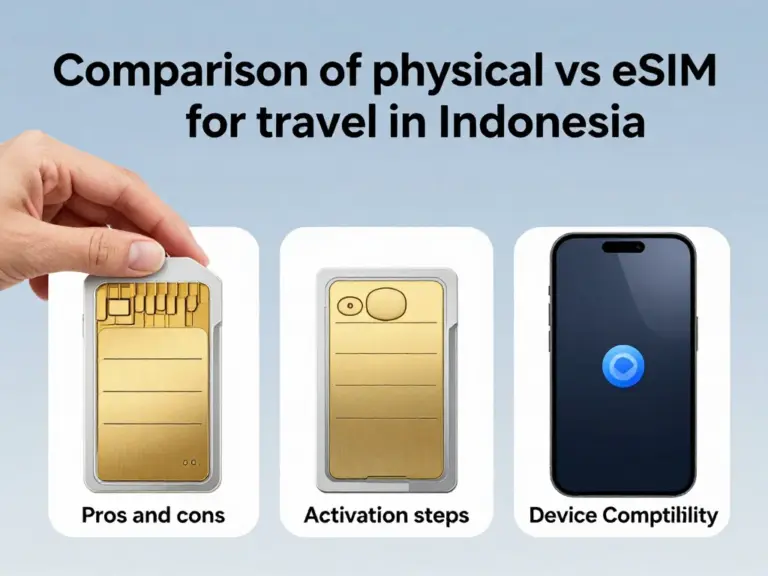
Which SIM vs eSIM Should You Choose for Travel or Long-Term Stay in Indonesia? — pros, cons, activation, and compatibility
- Which SIM vs eSIM Should You Choose for Travel or Long-Term Stay in Indonesia? — pros, cons, activation, and compatibility
Stepping off the plane at Soekarno-Hatta or Ngurah Rai International Airport, the first thing most travelers want is a reliable internet connection. Indonesia, a vast archipelago of over 17,000 islands, offers a unique digital landscape. When deciding on SIM vs eSIM Indonesia, the choice often depends on your length of stay, your device’s capabilities, and your tolerance for administrative hurdles like IMEI registration. This guide explores everything you need to know to stay connected while exploring the wonders of Indonesia .
Understanding the Connectivity Landscape in Indonesia
Indonesia has seen a rapid digital transformation. While physical SIM cards remain the traditional choice, the adoption of eSIM technology is skyrocketing among tourists and digital nomads. Major providers like Telkomsel, XL Axiata, and Indosat Ooredoo Hutchison offer robust 4G and growing 5G networks. However, the Indonesian government enforces strict regulations regarding mobile device registration to curb the black market, which significantly impacts how foreigners access local networks.
Physical SIM Cards: The Traditional Choice
For many, a physical Tourist SIM card is the go-to option. These are readily available at airport booths, official provider stores (GraPARI for Telkomsel), and small street-side kiosks known as ‘Konter HP’.
Pros of Physical SIMs
- Widespread Availability: You can find them almost anywhere, from remote villages to metropolitan malls.
- Cost-Effective: Local data packages are incredibly cheap compared to international roaming.
- Cash Payments: Ideal for those who prefer using Indonesian Rupiah (IDR) for transactions.
Cons of Physical SIMs
- IMEI Registration: Requires physical presence and passport verification.
- Risk of Loss: Swapping tiny chips increases the chance of losing your home country’s SIM card.
- Hardware Limitations: You need a physical SIM slot available in your phone.
eSIM: The Modern Traveler’s Best Friend
The SIM vs eSIM Indonesia debate often leans toward eSIM for short-term travelers. An eSIM (embedded SIM) allows you to download a data plan directly to your phone’s internal chip via a QR code.
Pros of eSIMs
- Instant Activation: Buy and install your plan before you even land in Bali or Jakarta.
- Convenience: Keep your home SIM active for SMS/OTP while using local data.
- No Physical Swap: No need to carry a SIM tool or worry about losing small parts.
Cons of eSIMs
- Device Compatibility: Only works on newer smartphones (iPhone XS and later, newer Samsung S-series, etc.).
- Limited Offline Support: You need a Wi-Fi connection to download and activate the profile initially.
Comparison Table: SIM vs eSIM Indonesia
| Feature | Physical Tourist SIM | Travel eSIM (e.g., Airalo, Holafly) | Local Provider eSIM |
|---|---|---|---|
| Ease of Purchase | High (Airport/Stores) | Instant (Online) | Moderate (Requires App/Visit) |
| Cost | Lowest | Higher | Low |
| IMEI Registration | Required (90+ Days) | Usually Bypassed | Required |
| Speed/Coverage | Excellent (Local) | Good (Roaming) | Excellent (Local) |
Activation and Compatibility
To use an eSIM in Indonesia, ensure your phone is “Carrier Unlocked.” If you choose a physical SIM, the provider will ask for your passport and your phone’s IMEI number (dial *#06# to find it). For short-term tourists (under 90 days), providers offer “Tourist Prepaid Cards” that bypass the permanent IMEI tax but still require registration with your passport.
Which One Should You Choose?
For Short-Term Travel (1-30 Days)
If you are visiting for a vacation, a Travel eSIM is the most convenient. You avoid the long queues at the airport SIM booths and stay connected the moment you turn off airplane mode. Providers like Airalo or Nomad offer specific Indonesia packages that are easy to manage.
For Long-Term Stay or Digital Nomads (3+ Months)
If you are staying long-term, a Physical Local SIM or a Local eSIM from Telkomsel is better. You will get much higher data quotas for a fraction of the price. However, you must visit a Customs office (Bea Cukai) at the airport upon arrival to register your IMEI and pay any applicable import taxes if your phone’s value exceeds $500 USD. This ensures your phone works indefinitely on Indonesian networks.
คำถามที่พบบ่อย (FAQ)
1. Can I buy an eSIM for Indonesia before I arrive?
Yes, international providers like Airalo, Holafly, and Maya Mobile allow you to purchase and install an Indonesian eSIM before your trip starts.
2. Does my phone support eSIM?
Generally, iPhone XS and newer, Samsung Galaxy S20 and newer, and Google Pixel 3 and newer support eSIM. Check your settings under ‘Cellular’ or ‘Network & Internet’ to confirm.
3. What happens if I don’t register my IMEI in Indonesia?
If you use a local SIM card without registering your IMEI, your phone will not receive a signal. However, international roaming on your home SIM will still work, and Wi-Fi remains accessible.
4. Which provider has the best coverage in Indonesia?
Telkomsel is widely regarded as having the best coverage, especially in remote areas and across the various islands of Indonesia.
References
- Telkomsel Official eSIM Guide
- Indonesian Customs (Bea Cukai) IMEI Information
- Official Indonesia Tourism Portal
- Getting a SIM Card or eSIM in Indonesia: Complete Guide to Coverage, Costs, and Top Providers
- How Much Do Indonesian SIM Cards and eSIMs Cost? — prepaid plans, data bundles, tourist packages, and tips to save
- Network Coverage and Speed Across Indonesia — comparison of Telkomsel, XL Axiata, Indosat Ooredoo, Smartfren, and regional limitations