Understanding gamelan music: instruments, rhythms, and what to expect from beginner-friendly workshops at cultural centers
- Understanding gamelan music: instruments, rhythms, and what to expect from beginner-friendly workshops at cultural centers
When you step into the lush landscapes of Java or Bali, a hauntingly beautiful, metallic resonance often fills the air. This is the sound of Gamelan, the traditional ensemble music of Indonesia. For many travelers, Understanding gamelan music is the key to unlocking the deep cultural heritage of the archipelago. Far more than just a musical performance, Gamelan is a communal spiritual experience that reflects the Indonesian philosophy of harmony and cooperation. Whether you are wandering through a royal palace in Yogyakarta or a village temple in Ubud, the rhythmic complexity of these bronze instruments offers a sensory journey unlike any other.
The Heart of the Ensemble: Core Instruments
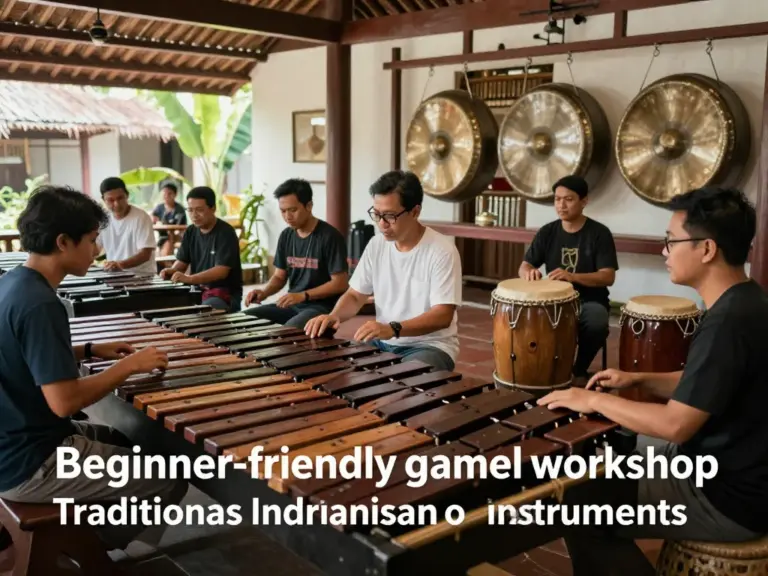
A Gamelan set is treated as a single entity; the instruments are built and tuned together, meaning they cannot be swapped with instruments from another set. The ensemble primarily consists of percussive instruments made of bronze, iron, or brass. To begin Understanding gamelan music, one must recognize the distinct roles within the orchestra. The Saron and Slenthem provide the core melody, while the Bonang (a collection of small pots) adds decorative flourishes. The Gong Ageng, the largest gong, marks the end of the longest melodic cycle, acting as the ‘soul’ of the entire ensemble.
| Instrument Type | Name | Role in Ensemble |
|---|---|---|
| Metallophones | Saron / Slenthem | Plays the main skeletal melody (Balungan). |
| Kettle Gongs | Bonang | Elaborates on the melody with complex patterns. |
| Large Gongs | Gong Ageng | Punctuation; marks the beginning and end of cycles. |
| Drums | Kendhang | The conductor; controls the tempo and dynamics. |
The Kendhang, or double-headed drum, is perhaps the most critical component for a beginner to watch. The drummer acts as the conductor, using subtle rhythmic cues to signal changes in speed or the transition to a new section of the piece. Watching the interaction between the drummer and the gong players is a masterclass in non-verbal communication.
Rhythms and Tuning: The Slendro and Pelog Systems
One of the most fascinating aspects of Understanding gamelan music is its unique tuning system, which differs significantly from Western scales. Gamelan music typically utilizes two scales: Slendro and Pelog. Slendro is a five-note (pentatonic) scale with roughly equidistant intervals, often described as sounding festive or bright. Pelog is a seven-note (heptatonic) scale with varied intervals, which can evoke a more somber, grand, or mysterious atmosphere. Because each ensemble is tuned to itself, the ‘C’ on one Gamelan might sound slightly higher or lower than the ‘C’ on another, giving every set its own unique ‘personality’ or ‘voice’.
The rhythm is cyclical rather than linear. In Western music, we often think of music moving from point A to point B. In Gamelan, the music is ‘colotomic,’ meaning it moves in circles. The large gong marks the completion of a circle, representing a return to the source. This cyclical nature is deeply tied to Indonesian concepts of time and reincarnation, making the music a meditative experience for both the player and the listener.
What to Expect from Beginner-Friendly Workshops
For tourists visiting cultural hubs like Ubud in Bali or Yogyakarta in Java, participating in a Gamelan workshop is a highly recommended experience. These workshops are designed for those with zero musical background. When you arrive at a cultural center, such as the ARMA Museum in Bali or the Kraton in Yogyakarta, you will likely be asked to remove your shoes as a sign of respect for the instruments. Understanding gamelan music through practice is much more effective than just listening. You will be assigned a simple instrument, usually a Saron, and taught a basic 4- or 8-beat melody.
In a typical 2-hour workshop, you can expect to:
1. Learn the basic etiquette of the Gamelan pavilion (Pawon).
2. Understand how to hold the mallets (Panggul) correctly.
3. Practice ‘damping’ the notes with your thumb to stop the resonance—a vital technique in Gamelan.
4. Perform a short, complete piece with the rest of the class. It is an incredibly rewarding feeling when the group finally syncs up and the ‘shimmer’ of the bronze begins to vibrate through the room.
Why Gamelan is Essential for Indonesia Tourism
For the modern traveler, Understanding gamelan music provides a gateway into the Indonesian soul. It is not just art; it is a social glue. In villages, Gamelan practice is a time for the community to gather. By joining a workshop, you aren’t just learning a skill; you are participating in a living tradition that has survived for centuries. It offers a break from the fast-paced digital world, forcing you to listen intently to those around you and find your place in the collective harmony.
คำถามที่พบบ่อย (FAQ)
Do I need musical experience to join a Gamelan workshop?
No, beginner workshops are designed for everyone. The basic melodies are easy to follow, and the focus is on group coordination rather than individual virtuosity.
What should I wear to a cultural center?
Modest clothing is preferred. Most centers require you to remove your shoes before entering the Gamelan area. Wearing a sarong is often encouraged in Balinese temples.
How long does a typical beginner session last?
Most introductory workshops last between 90 minutes to 3 hours, which is enough time to learn a simple traditional piece.
Is Gamelan music different in Bali and Java?
Yes. Balinese Gamelan (Gamelan Gong Kebyar) is often faster, more energetic, and explosive. Javanese Gamelan is typically slower, more meditative, and courtly.
References
- Official Indonesia Tourism – Yogyakarta Culture
- UNESCO Intangible Cultural Heritage – Gamelan
- ARMA Museum & Resort – Cultural Workshops
- Inside Javanese Court Culture: Experiencing Kraton Yogyakarta, Batik Crafting, and Gamelan Workshops for Authentic Cultural Immersion
- What is the Kraton of Yogyakarta? History, architecture, and the court traditions that shape Javanese identity
- How to join batik workshops near the Kraton: techniques, materials, and choosing authentic hands-on experiences