Why Slow Travel in Indonesia Is the Smartest Low-Carbon Way to Explore the Archipelago
As the world becomes increasingly aware of the environmental costs associated with mass tourism, travelers are seeking more meaningful and responsible ways to see the globe. For those drawn to the incredible biodiversity and cultural richness of Southeast Asia, slow travel in Indonesia offers a compelling solution. By choosing to linger longer in fewer destinations, you aren’t just reducing your carbon footprint; you are unlocking a deeper, more authentic connection to the archipelago’s diverse islands.
The Philosophy of Slow Travel in Indonesia
Slow travel is the antithesis of the frantic “checklist” tourism that often characterizes modern vacations. Instead of hopping from Bali to Komodo to Raja Ampat in a single week—a practice that relies heavily on carbon-intensive short-haul flights—slow travel encourages immersion. When you embrace slow travel in Indonesia, you choose to deeply explore a single region, province, or island. This approach drastically cuts down on internal flights, which are often the largest contributor to a traveler’s carbon footprint while visiting the region.
Reducing Your Carbon Footprint Through Local Engagement
The environmental impact of tourism isn’t just about the mode of transport; it is also about consumption patterns. Slow travel allows you to participate in the local economy more effectively. Instead of staying at large, international resort chains that often have high energy demands, slow travelers tend to favor locally-owned guesthouses, homestays, and boutique eco-lodges. These accommodations typically have a lower environmental impact and ensure that your tourism dollars directly support the local community.
The Benefits of Staying Longer
- Reduced Emissions: Fewer flights and less reliance on high-energy transport infrastructure.
- Economic Impact: Your spending stays within the community, fostering sustainable development.
- Cultural Depth: You move beyond the surface level, learning local customs, languages, and traditions.
Transportation Choices: The Low-Carbon Way
To truly master low-carbon exploration in Indonesia, you must reconsider how you move between islands. While the archipelago is vast, prioritizing ground travel where possible is key. For example, traversing the island of Java by train offers some of the most spectacular volcanic landscapes in the world while being significantly greener than flying. When sea travel is necessary, opting for larger, slower ferries instead of private speedboats can also reduce the energy consumed per passenger.
| Mode of Transport | Carbon Intensity | Slow Travel Potential |
|---|---|---|
| Short-haul Flight | High | Low |
| Private Speedboat | Medium-High | Medium |
| Train (Java) | Low | High |
| Public Ferry | Low | High |
Embracing the Pace of Island Life
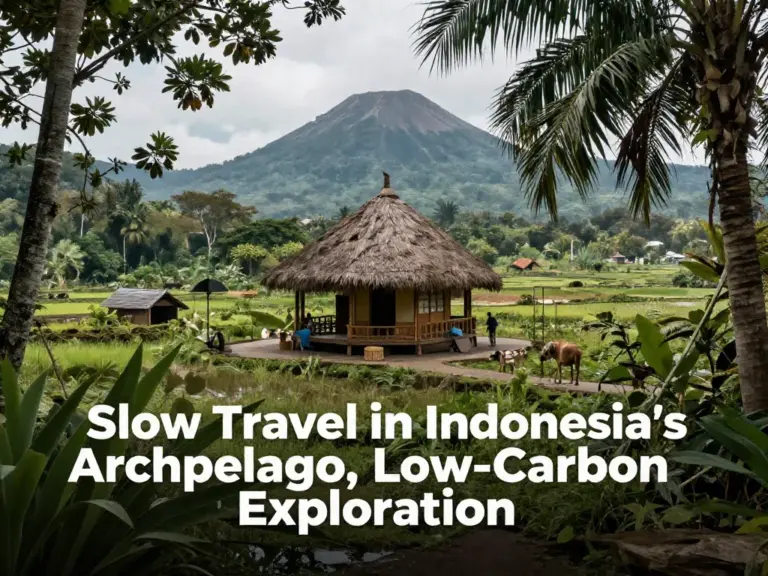
Indonesia is a country that operates on ‘Jam Karet’ (rubber time). While this can be frustrating for the uninitiated, it is actually the perfect rhythm for the slow traveler. By slowing down, you align yourself with the natural pace of the environment. You have time to visit local markets, participate in community events, and engage with the environment without the pressure of a flight schedule. This shift in mindset is the ultimate form of sustainable tourism, transforming the traveler from a passive consumer of scenery into an active participant in the destination’s ecosystem.
Ultimately, choosing to practice slow travel in Indonesia is a commitment to quality over quantity. It is a recognition that the archipelago is not merely a collection of “must-see” photo opportunities, but a complex, fragile, and beautiful home to millions. By slowing down, you protect the very places you have traveled so far to see.
คำถามที่พบบ่อย (FAQ)
1. Is it difficult to travel slowly in Indonesia?
Not at all. While the geography is vast, there are extensive bus, train, and ferry networks. The primary challenge is adjusting your mindset to take more time for travel between regions.
2. What is the best region for a slow travel itinerary?
Java is excellent for slow travel due to its robust train network, while Bali or Lombok are perfect for those wanting to stay in one place and explore villages and nature thoroughly.
3. Does slow travel cost more?
Often, it costs less. By staying in one place, you can negotiate better rates for long-term accommodation, eat at local markets, and save significantly on expensive short-haul flights.