Javanese Keris Makers in Solo Workshops Museum and Meanings
The city of Solo, also known as Surakarta, stands as the beating heart of Javanese civilization. Among its most prestigious cultural treasures is the Keris—a distinctive, asymmetrical dagger that is much more than a weapon. For centuries, Javanese Keris makers in Solo, known as Empu, have blended metallurgy, art, and spirituality to create blades believed to possess supernatural powers. In this guide, we explore the living traditions of these master craftsmen, the museums that preserve their legacy, and the profound philosophy embedded in every curve of the blade.
The Empu: Master Javanese Keris Makers in Solo
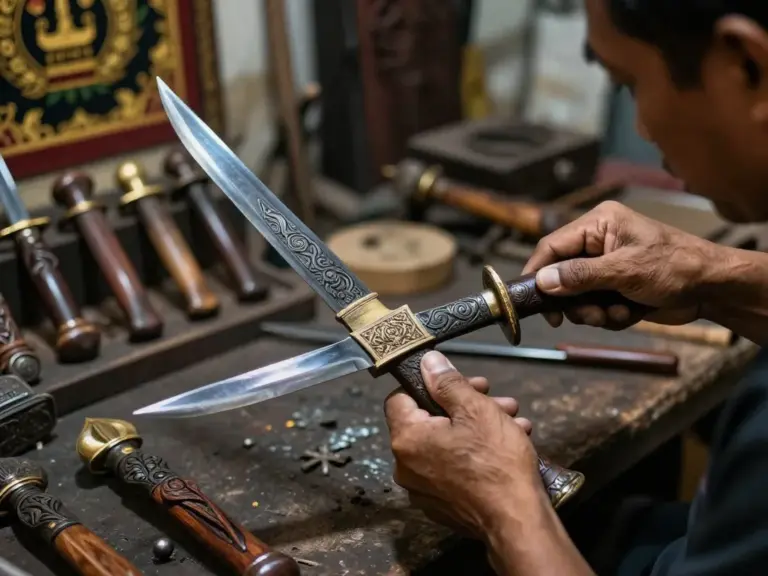
An Empu is not merely a blacksmith; they are highly respected figures who undergo spiritual preparation before forging a blade. In Solo, the tradition is passed down through generations. The process of making a Keris involves ‘Besalen’ (the workshop), where the Empu layers different types of iron and nickel—sometimes even meteoric iron—to create the ‘Pamor’ (the visible pattern on the blade). This process can take weeks or even months of meticulous hammering and folding.
Visiting the Living Workshops (Besalen)
For travelers interested in Javanese Keris makers in Solo, visiting a functional Besalen is a transformative experience. One of the most famous areas for this is the Palur district or near the Keraton (Palace) precincts. Here, you can witness the rhythmic strike of the hammer and the intense heat of the charcoal forge. The Empu often welcomes visitors who show genuine respect for the craft, offering insights into the symbolic meaning of the specific Pamor being forged.
Museum Keris Nusantara: A Gateway to History
If you wish to see the finest examples of craftsmanship without traveling to individual workshops, the Museum Keris Nusantara in Solo is an essential stop. This modern five-story building houses thousands of Keris from across the Indonesian archipelago, with a heavy focus on the Surakarta style. The museum provides detailed explanations of the different parts of a Keris, such as the hulu (handle), warangka (sheath), and the wilayah (blade) itself.
| Feature | Description |
|---|---|
| Pamor | The decorative pattern resulting from forging different metals. |
| Dhapur | The specific shape or design of the blade (straight or wavy). |
| Luk | The number of curves on a wavy blade, always an odd number. |
Spiritual Meanings and Philosophy
The Keris is a symbol of heroism, social status, and a bridge to the divine. Javanese Keris makers in Solo believe that a Keris should match the personality and destiny of its owner. A straight blade (lurus) often represents steadfastness and focus on God, while a wavy blade (luk) represents the dynamic flow of life and ambition. Many Javanese families still keep a Keris as a Pusaka (heirloom) to protect the household and bring prosperity.
How to Experience Keris Culture in Solo
To fully immerse yourself, consider attending a ‘Jamasan’ ceremony, usually held during the Javanese month of Suro. This is a ritual cleaning of the Keris to maintain its physical and spiritual integrity. You can also visit the Triwindu Antique Market to see vintage Keris, though purchasing one requires a discerning eye or the guidance of a local expert to distinguish between a souvenir and a true cultural artifact.
คำถามที่พบบ่อย (FAQ)
1. Where can I see Javanese Keris makers in Solo?
You can visit the Museum Keris Nusantara for a comprehensive overview, or head to traditional workshops (Besalen) in the Surakarta area, such as those near the Palur region or the Keraton.
2. Is the Keris still used today?
Yes, the Keris is an essential part of traditional Javanese attire for ceremonies, weddings, and cultural events. It remains a powerful symbol of identity.
3. Can tourists buy a Keris in Solo?
Yes, you can buy modern Keris as souvenirs at markets like Triwindu or commission a custom one from a master Empu. Be sure to check export regulations for antique items.
4. What makes a Solo-style Keris unique?
The Solo (Surakarta) style is known for its elegant, slightly more flamboyant sheath designs (Ladrang) and refined blade carvings compared to the more austere Yogyakarta style.
References
- UNESCO: Indonesian Kris Heritage
- Official Portal of Surakarta City Administration
- Wonderful Indonesia – Official Tourism Website
- What searchers want to know about who makes Javanese keris in Solo: profiles of traditional makers, workshop locations, and how to visit them (workshops, tour tips, opening hours)
- Historical and cultural significance of the keris in Solo: origins, meanings of motifs and symbolism, and how museums present keris heritage
- How keris are made today in Solo workshops: step-by-step craft process, materials, forge techniques, pamor patterns, and modern adaptations